
Live Events
Online Courses
Courses
 Clinical Running EssentialsSelf-paced, 29 hours, CEU‑approved.View course Clinical Running EssentialsSelf-paced, 29 hours, CEU‑approved.View course
New! Online Course

Taught by Chris Johnson, PT
📖 100% Online, Self-Paced Course
🏅 Approved for CEUs for PTs (details below)
🔄 Lifetime Access
Designed for clinicians working with runners or eager to expand into running-related care, this course distills 20+ years of clinical expertise into a clear, evidence-based approach, eliminating guesswork and improving clinical decision-making.
Early in my career, I assumed my clinical education had fully prepared me to treat runners.
After all, I understood biomechanics, tissue loading, and rehabilitation principles. But once I started working with runners in practice, I quickly realized something was missing.
Runners weren’t responding the way I expected. Some injuries kept coming back. Others worsened despite following “best practices.”
I saw bone stress injuries that were initially (dis)missed, tendinopathies that didn’t improve, and runners eager to return to training before they had fully restored tissue capacity.
I started asking myself: What am I missing?
That question led me down a path of deeper study, hands-on experience, and learning from some of the best in sports medicine.
Over the past 20 years, I’ve worked as a clinical research assistant at NISMAT, collaborated with top surgeons, coached endurance athletes, and competed in marathons and Ironmans.
Through all of it, I developed a clearer, more structured approach to running injuries—one that bridges the gaps I didn’t even know existed when I started.
I refined an approach that integrates:
✔ Identifying injury patterns unique to runners before they become chronic
✔ Using objective performance tests to ensure actual return-to-run readiness
✔ Applying progressive loading principles that work in practice
✔ Communicating effectively with runners to improve adherence and long-term outcomes
That’s why I created Clinical Running Essentials.
This course isn’t about learning protocols or a specific system—it’s about ensuring that clinicians treating runners have a strong foundation in the essentials.
It’s the knowledge I wish I had earlier in my career, structured in a way that makes it easy to absorb and apply.
By completing this course, you’ll cover all critical areas of running injury management, refine your clinical reasoning, and provide better care for runners—so they can return to the sport they love with confidence.
Clinical Running Essentials is approved for CEUs for Physical Therapists by the California, New York, Texas, and Illinois Physical Therapy Associations, and directly by the Minnesota Board of Physical Therapy. It is recognized by most other state PT boards.
Credit awarded varies by state. Each approving body uses its own calculation and operates on its own approval cycle.
| California | 2.98 CEUs (#25-307) |
|---|---|
| New York | 28.4 hours (#80618) |
| Texas | 29.8 CCUs (#82228TX) |
| Minnesota | 20 CE hours (#14158) |
| Illinois | 29.5 CE hours (#1053-10109) |
| All other states | Most state PT boards recognize CEUs approved by the TX, NY, and CA Physical Therapy Associations, except the states shown in grey on the map, which require separate approval. Washington, DC typically accepts these approvals but may have additional requirements. |
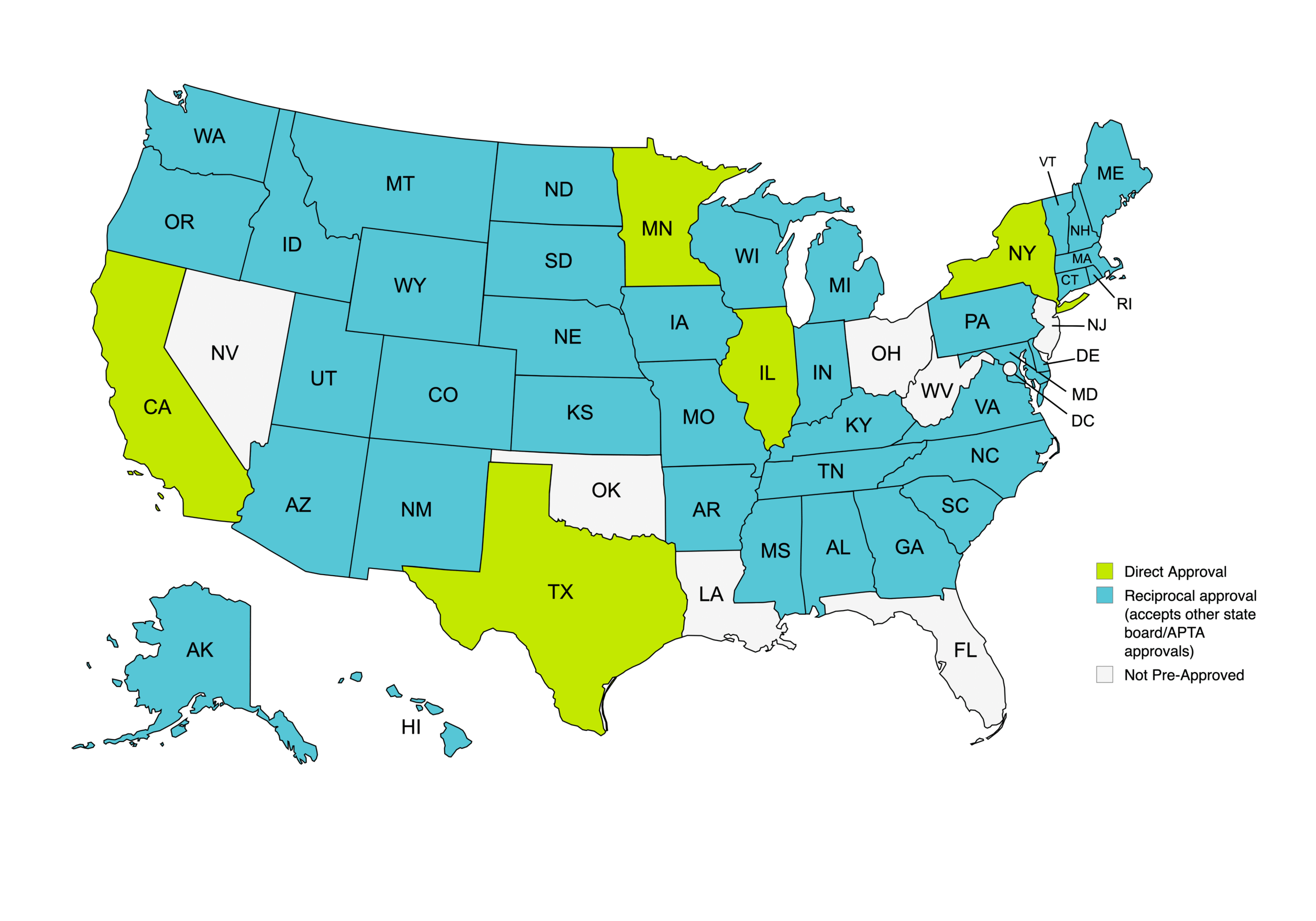
Licensees should confirm with their own state board if CE credit is the reason for enrolling.
Instructional level: Intermediate.
This course content is not intended for use by any participants outside the scope of their license or regulation.
Clinical Running Essentials is designed for clinicians who work with runners or wish to expand their expertise in treating running-related injuries.
It provides a structured, research-supported approach to managing the most critical conditions encountered in endurance athletes.
This course is most relevant for:
If you work with runners recovering from injury, experiencing persistent pain, or optimizing performance, this course ensures you are thoroughly equipped to address their needs.
This course gives you the exact knowledge, skills, and tools to confidently assess and manage runners at every stage—from injury to peak performance.
Topics include:
🦴 Bone Stress Injuries – Detect early signs, understand imaging, and apply risk models to prevent mismanagement and ensure safe recovery.
🔹 Lower Limb Tendinopathies – Assess and treat Achilles, patellar, glute med, and proximal hamstring tendinopathies with progressive loading and return-to-run protocols in the context of the bio-psycho-social model.
📊 Physical Performance Testing – Use structured assessments to test tissue capacity specific to the performance demands of running while ensuring full readiness for return to sport.
🧠 Communication & Behavior Change – Use motivational interviewing and educational strategies to improve alliance, foster autonomy, and enhance rehab engagement.
🏋️♂️ Strength & Control Drills – Restore capacity through a combination of progressive loading as well as power and plyometric drills while implementing motor control strategies to enhance running economy, reduce injury risk, and improve movement efficiency.
📈 Return-to-Run Programming – Use criteria-based progressions to guide runners back to training with objective checkpoints and benchmarks to prevent re-injury.
📏 Orthopedic & Clinical Examination – Apply evidence-based assessments to evaluate runners’ joint integrity, soft tissue health, and functional movement.
👟 Running Biomechanics – Develop a structured approach to gait analysis, load management, and movement optimization.
💡 Case Studies & Clinical Applications – Refine diagnostic and treatment skills with real-world runner case studies for seamless clinical application.
This course eliminates the uncertainty of working with runners, giving you the structured, proven tools to help your patients recover, stay injury-free, and perform at their highest level.
Running is one of the most accessible and beneficial forms of exercise, yet it has a high risk and incidence of lower extremity injuries. Research shows that nearly 80% of runners sustain an injury each year, often due to overuse-related conditions, frequently resulting in bone stress injuries, tendinopathies, and fasciopathies.
When not correctly identified and managed, these injuries can become chronic, delaying return to sport for weeks, months, or even years. In severe cases, mismanagement can lead to long-term impairments that impact athletic longevity and overall health.
Clinicians treating runners must understand the sport’s unique biomechanical and performance demands, the pathophysiology of common injuries, and evidence-based rehabilitation strategies.
This course provides a structured, research-driven approach to help clinicians accurately assess, manage, and guide runners out of the medical system and back to pain-free, sustainable training.
Format: 100% Online, self-paced course
Length: 29.8 hours
Content types:| Topic | Approx. Length | Sample Video | |
|---|---|---|---|
| Module 1 | Welcome & Course Orientation How to Get the Most Out of This Experience | 35 mins | - |
| Module 2 | Talking to Runners Motivational Interviewing, Alliance Building, and Inductive Foraging In this module, you'll:
| 59 mins | |
| Module 3 | Running Biomechanics Simplified What Clinicians Need to Know In this module, you'll:
| 37 mins | - |
| Module 4 | The Modified Wilk Scale Staging and Typing Running-Related Pain and Injury In this module, you'll:
| 11 mins | |
| Module 5 | Orthopedic Examination of Runners Strategies for Direct Access Providers | 65 mins | - |
| Module 6 | The Table Torsion Test™ Revealing an Overlooked Clinical Pattern in Runners In this module, you'll:
| 45 mins | |
| Module 7 | Physical Performance Testing Establishing Baselines, Benchmarks, and Clearance Criteria for Safe Return to Running In this module, you'll:
| 73 mins | |
| Module 8 | Taming Lower Limb Tendinopathy Tendon-Specific, Individualized Care for Runners In this module, you'll:
| 321 mins | |
| Module 9 | Bone Stress Injuries (BSIs) Step by Step, Bone by Bone – What you need to know In this module, you'll:
| 436 mins | |
| Module 10 | Drills for Running Mastery With Special Consideration for Bone and Tendon Health | 240 mins | |
| Module 11 | Decoding a Runner’s Signature Qualitative & Quantitative Gait Analysis and Retraining for Clinicians In this module, you'll:
| 97 mins | |
| Module 12 | Resistance Training for Runners Programming, Progression, and Autoregulation Basics In this module, you'll:
| 80 mins | - |
| Module 13 | Run Programming & Testing What you need to know as a clinician In this module, you'll:
| 54 mins | |
| Module 14 | Running Footwear Selection, Screening, and Clinical Considerations | 13 mins | - |
| Module 15 | Case Studies Tibial BSI, calcaneal BSI, lesser trochanter BSI | 222 mins | - |
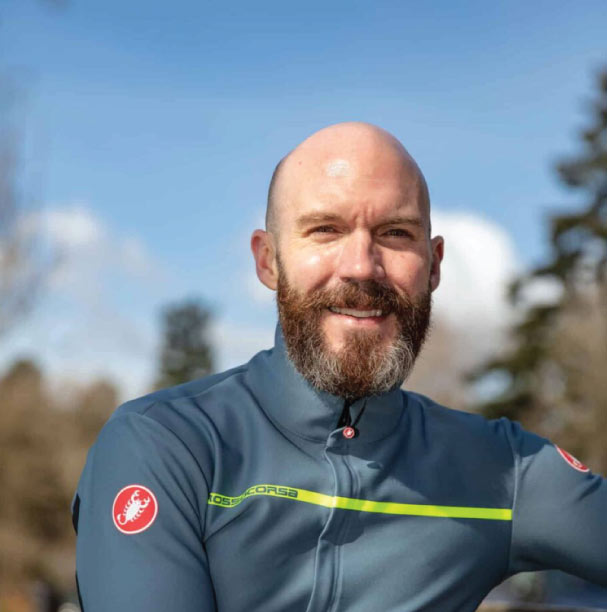
Chris completed his undergraduate studies at the University of Delaware, earning a Bachelor of Science with distinction while conducting a senior thesis under Dr. Lynn Snyder-Mackler. He was a varsity men’s tennis team member, scholar-athlete, and team captain in 2000, receiving the Lee J. Hyncik Award for excellence.
He stayed at Delaware for a physical therapy degree, completing an orthopedic/sports fellowship under Dr. Michael J. Axe. After graduation, he worked at NISMAT at Lenox Hill Hospital in NYC for eight years. In 2010, he opened Chris Johnson PT PLLC in Manhattan’s Flatiron District.
In 2013, Chris moved to Seattle, founded Zeren PT LLC, and later Alchemy Endurance for multisport and endurance athletes. He is a recognized authority in the endurance space, working with runners and triathletes. Chris is also a sought-after speaker, clinical educator, and business coach.
Chris lives in Edmonds with his wife and two kids, continuing to compete in distance running.
You can read more about Chris here.
Clinical Running Essentials
The foundational knowledge, skills, and expertise every clinician who treats runners needs
🖥️ 100% Online & Self-Paced Course – Learn at your own pace, on your schedule.
🔄 Lifetime Access & Updates – Get all future course updates, including new content.
🎓 Earn CEUs – Approved in CA, NY, TX, MN & IL, and recognized by most other state boards
📂 Practical Tools & Resources – Downloadable PDFs, guides, and case studies.
👨⚕️ Expert-Led Instruction – 20+ years of clinical experience distilled into an actionable course.
📌 Bonus Case Study Modules – Tibial BSI, calcaneal BSI, lesser trochanter BSI
$795 USD
Add to cartLifetime Access
Money-back guarantee
After completing your purchase, you will receive an email with a username and password. You’ll also be automatically logged into the website. To access the course anytime, click the Profile icon in the top right corner of the website, log in, and navigate to the Courses section in the member area.
When you purchase Clinical Running Essentials, you get lifetime access, including all future updates. If new modules, sections, or content updates are added, they will automatically be available in your course at no additional cost.
Clinical Running Essentials is designed for clinicians who work with runners in a clinical setting. This includes physical therapists, chiropractors, athletic trainers, and other healthcare professionals who assess and treat running-related injuries.
While others may find the material valuable, this is a clinically focused course, not just a general overview of running mechanics. If you’re a clinician or someone looking to learn clinical-level information about working with runners, this course is for you.
Yes, we offer a 48-hour refund policy. Selling digital products comes with unique challenges, and we want to ensure you’re happy with your purchase while also protecting the integrity of the educational material. If the course is completely off base for what you expected, you can request a refund within 48 hours of purchase. However, this policy helps prevent piracy and ensures that the course remains valuable for all participants.
Yes! Clinical Running Essentials is approved for CEUs for Physical Therapists in CA, NY, MN, TX, and IL and recognized by most other state PT boards.
Please refer to the Continuing Education section of this page for full details.
No, there are no prerequisites for Clinical Running Essentials. The course is designed to be accessible for clinicians, coaches, and anyone looking to deepen their understanding of running-related assessment and treatment strategies. Whether you’re new to treating runners or have years of experience, you’ll find valuable insights and practical applications.
Chris’ Clinical Running Essentials course is the most comprehensive course for treating runners I have ever come across. Chris is a true master of his craft and it shows in this product.
The course covers everything from how to perform a subjective and objective examination specific to runners, making a diagnosis, and crucial expert insights into nailing your rehab programs. The course also includes exercise demonstration videos by none other than Chris himself.
I honestly can’t say enough about this course. It is one I continue to come back to when I’m seeing a runner to make sure I’m being as comprehensive as possible.
Do yourself, your clinic, and your patients a favor and take this course!
So, this might sound a little cocky, but I’d say over the years I’ve gotten pretty good at working with runners. I’m fairly familiar with the demands of the activity at all levels, and I have a good grasp of what’s going on with most running injuries, what things need to be done at key points throughout the rehab journey, and bridging the gap between rehab and performance.
On top of that, this is not the first course I’ve taken with Chris Johnson, so I’m fairly familiar with how he thinks. Much of his way of doing things has informed my own clinical philosophy over the years.
With all that said: Chris completely outdid himself with clinical running essentials. Somehow, he was able to build upon his already prolific and impactful knowledge that he shares openly, and share deeper and fresher takes than ever before. It completely revamped how I think about so many topics in running rehab that I thought I already had a good grasp of. All the while, he does this in a way that’s super easy to understand, leading with principles that any clinician can implement straight away on their own terms.
This course is an absolute magnum opus and I would highly recommend it to EVERY clinician that works with runners in any capacity. Simply put, this course will level you up as a clinician in every way. PERIOD.
Learning to navigate the good, the bad, and the ugly parts of running injury and performance is a daunting task, but Chris somehow has found a way to put it all in one spot. Chris is knowledgeable, entertaining, and will always circle back to treating the person in front of you. If you treat runners or triathletes, this resource is a must have.
This offers a refreshing perspective on working with runners. I appreciated the thorough detail Chris provided when teaching softer skills for interacting with our patients. The content covers everything from bones and tendons to exercise progression. Definitely worth a look!
Chris seems to be someone who is looking to get it right, not be right, and his Master Class reflects that.
With one runner, the course gave me a much better understanding of bone stress injuries and the confidence to use my DPT training to assess his risk, establish appropriate guardrails, and help him continue running rather than getting stuck waiting for certainty from imaging.
Even something as simple as better understanding the actual plantarflexion demands of running changed how I interpreted his symptoms and modified his calf work.
Most importantly, it helped me get an anxious runner unstuck, keep him running with appropriate guardrails, and help him return to his identity as an uphill athlete, including participation in the Taco Bell 50k.