The Final Year of the Ironman St. George Experience

by Chris Johnson on May 9, 2012

This video provides a good overview of the race. While many of my good friends and family think I was exaggerating how tough the conditions were, this video gives you proof. You may also recognize the person 30 seconds in to the video getting lubed up…

YouTube Preview Image
Please share with others:
  • Print
  • email
  • Facebook
  • Twitter
  • del.icio.us
  • LinkedIn
  • Digg
  • StumbleUpon
  • Tumblr
  • Posterous
  • Yahoo! Buzz
  • Google Bookmarks
  • FriendFeed
  • HealthRanker
  • Plurk
  • Reddit
  • SphereIt
  • Technorati

{ 0 comments }

The Hardest Thing I’ve Ever Done

by Chris Johnson on May 7, 2012

This past Saturday I raced Ironman St George; the single hardest one day event up to this point in my life. I originally picked this race, as I knew it would favor my strengths as a triathlete. I was also excited because just a week before the race, the World Triathlon Corporation (WTC) announced that 2012 would be the last year St. George was be a full Ironman, and I would have the final opportunity to race it as a 140.6 (total mileage of an ironman).

After waking up at 3:45am to down 1250kcal, I made my way down to the lobby of the hotel to catch a shuttle to Town Square where buses were waiting to transport athletes to the swim start. Just before the shuttle departed, I vividly remember a woman remarking how it was going to be an amazing day for racing as there was no little to no wind as she gestured towards some nearby trees, which stood motionless. The jinx was upon us! After arriving to the transition zone at Sand Hollow Lake, we made our way down to the swim start and fortunately the water was relatively calm, at least for the time being.

After working my way to  the front of the pack to claim a good starting position, the gun went off and the race was underway. The initial half-mile was going according to plan and the water was perfect. As we made our first left, however, the conditions took a dramatic turn for the worse. Suddenly the winds hit and three to five foot swells were upon us. Not only was it challenging to swim through the choppy water, but sighting the buoys was virtually impossible. It felt as if someone dropped me in the middle of the ocean while a helicopter hovered overhead. I even remember seeing three kayakers, who were officiating the race, get toppled over. It was absolute mayhem. Apparently 300 athletes pulled out of the race after the swim.

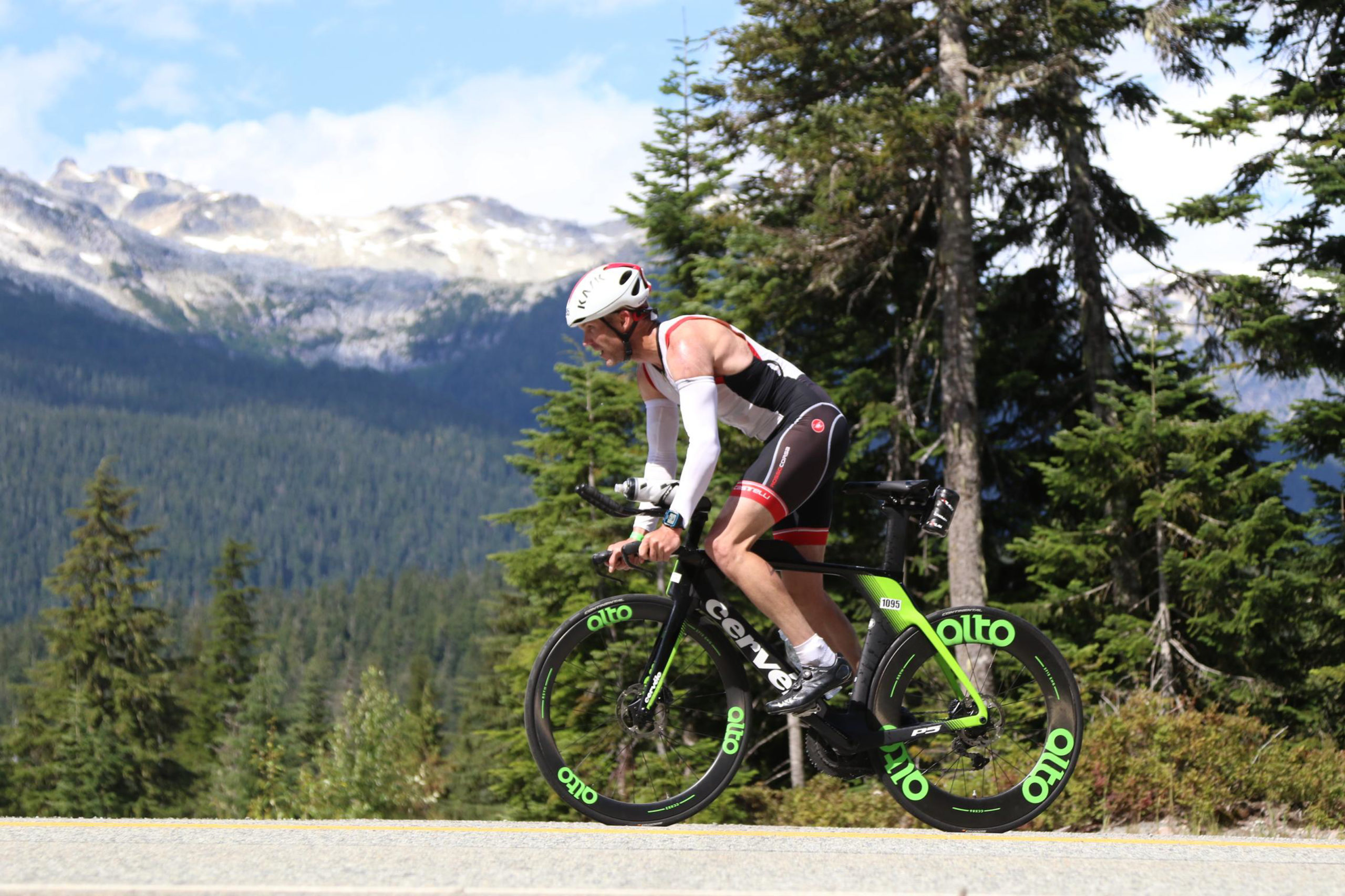
After emerging from the water and heading out on the bike, athletes were greeted with a gnarly head wind, which felt to be about 30+ mph. I knew at this point that we were in for a long day of pain and suffering; exactly what I had signed up for. The bike leg only got worse as the race unfolded and we hit the hills or shall I say mountains. Between rough roads, strong winds, little protection from the elements, and the sun beating down upon us, we had our work cut out. I never recall seeing so many people pull off the bike course due to cramping and sheer exhaustion. After completing the second loop of the bike course, I couldn’t have been more relieved to get off the bike as I was going in to T2 (bike to run transition).

After the volunteers coated me with sun tan lotion coming out of T2, all that remained was a marathon. The run course consisted of three monotonous loops. Fortunately my Queen (Mimi), was there to cheer me on throughout the run, which proved to be a battle of attrition. I felt surprisingly good during the first half of the marathon, which I completed in just over 1.5hrs. The second half of the race, however, was a different story thanks to a massive blister on the bottom of my left foot. Fortunately, I was able to dig deep and make it home.

Never have I been more relieved to finish a race as I was crossing the finishing line of Ironman St. George. While I wish that the race would be kept at the full ironman distance in upcoming years, it’s understandable why it has been switched to a 70.3 moving forward. For any triathlete, who wants to be tested, this is the race for you!

Special thanks to all the volunteers as well as my friends and family, who took the time out of their busy schedules to track my suffering online. Id also like to thank my good friend Tibor, founder of Formula Triathlon Club, who took the time to discuss race strategy with me on a few different occasions. Lastly, I’d like to thank my fiancé, Mimi, who makes all of this nonsense possible and never stops to question why I like to train two to three times a day and wear mandex!

Wishing you happy, healthy, and strong training!

YouTube Preview Image
Please share with others:
  • Print
  • email
  • Facebook
  • Twitter
  • del.icio.us
  • LinkedIn
  • Digg
  • StumbleUpon
  • Tumblr
  • Posterous
  • Yahoo! Buzz
  • Google Bookmarks
  • FriendFeed
  • HealthRanker
  • Plurk
  • Reddit
  • SphereIt
  • Technorati

{ 16 comments }

Functional Barefoot Running – Preparing for T1

Coaches have long used mindful and purposeful barefoot running to prepare triathletes for the swim to bike transition (T1). The most appropriate running method to utilize during T1 is a flatfooted, balanced stride. A forefoot sprinting stride is not appropriate because of the risk of delaying transition vasodilatation (widening of blood vessels). Blood has to be moved from your swimming to biking muscles and this process takes time even in the fittest triathletes. Since the run from the swim exit to the transition zone can be a half-mile or more on asphalt, a heel striking pattern should also be avoided to protect the heels from inadvertently over-striking on hard, uneven surfaces. To prepare triathletes for running during T1, a combination of barefoot balance drills and stride drills should be included in a training program. Balance exercises should be practiced in front of a mirror in order to develop a balanced, barefoot stride while stride drills should be performed unshod (barefoot) on a safe surface.

Once you reach the run leg of the triathlon, it’s time to revert back to your usual training shoes and stride. Understand that you will run faster and safer in a properly fitted, manufactured running shoe, than if you ran this portion of the race unshod. Below is a list of drills to help prepare you for a smooth and timely T1 transition. The ultimate goal of these drills is to foster a balanced, flatfooted stride. It should be mentioned that the term gliding is used to describe a running pace of 5-7mph.

Glide Drill – Arms In

Action 1. During glides, purposely overswing your arms in front of your body until you begin to feel out of balance.2. Bring your arms back into correct armswing position to find your balance.
Focus Notice how the position and motion of your arms affects your balance.


Glide Drill – Arms Out

Action 1. During glides, purposely rotate your armswings outward, away from your body, until you begin to feel out of balance.2. Bring your arms back into correct armswing position to find your balance.
Focus Notice how the position and motion of your arms affects your balance.


Glide Drill – Feet In

Action 1. During glides, purposely rotate your leg inwards, toes pointing in, just until you begin to feel out of balance. (Don’t rotate so much that it causes you to stumble.)2. Rotate your legs back into a normal, forward position to find your balance.
Focus Notice how the alignment of your legs and feet affects your balance.


Glide Drill – Feet Out

Action 1. During glides, purposely rotate your legs outwards, toes pointing to the sides, just until you begin to feel out of balance. (Don’t rotate so much that it causes you to stumble.)2. Rotate your legs back into a normal, forward position to find your balance.
Focus Notice how the alignment of your legs and feet affects your balance.


Glide Drill – Hands on Head

Action 1. During glides, place both hands on top of your head.2. Keep the elbows pointed straight out to the sides. Do not twist the upper body.3. Tighten the muscles of the trunk to help control your balance.4. Run with your body straight, feet straight, and chin tucked.5. Running motion should be straight forward, not side to side.
Focus Maintain the alignment of the trunk over the pelvis while keeping the arms stationary.


One-Legged Armswings, Barefoot

Regions 1. Toes, arch
Equipment* Hand weights
StartingPosition 1. Stand barefoot on a level surface, with “straight” posture.2. Bend one knee 90 degrees so the lower leg is parallel to the floor (kickback position).2. Holding a hand weight in each hand, bend elbows to 90 degrees.
Action 1. Slowly swing your arms from the shoulder, keeping the elbows bent and close to the body. As one arm moves forward, the other arm moves backward.2. Alternate legs before you lose your balance.
Focus 1. Work the ground with your foot while using your arms to help maintain your body straight and balanced over the weight-bearing leg.2. The only part of your body moving should be the balanced armswing.3. Create symmetry.4. Build up to your glide rhythm and target time.


Barefoot Push-Up

Regions 1. Toes, heel
Equipment* None
StartingPosition Barefoot, stand in “straight” posture, elbows bent 90 degrees.
Action 1. Raise one knee to the “high knees” position, keeping your foot aligned under the bent knee, and hold.2. Move your armswing to the coordinated position for balance, and hold.3. Push up through the big toe of the weight-bearing leg, lifting the heel off the ground.
Focus 1. Try to maintain a small, smooth, controlled motion as you transition from the flatfoot position to  the big toe.2. Try to keep your body straight and balanced while your weight moves forward and up into a pushoff position.3. Create symmetry.4. Build up to your glide rhythm and target time.
YouTube Preview Image
Please share with others:
  • Print
  • email
  • Facebook
  • Twitter
  • del.icio.us
  • LinkedIn
  • Digg
  • StumbleUpon
  • Tumblr
  • Posterous
  • Yahoo! Buzz
  • Google Bookmarks
  • FriendFeed
  • HealthRanker
  • Plurk
  • Reddit
  • SphereIt
  • Technorati

{ 0 comments }

Everyday I work with patients and athletes to overcome functional limitations and improve performance, respectively. Today, I wanted to highlight the recent accomplishment of a woman, who worked with me in preparation for a half marathon. Despite initially having reservations about even lining up for the half marathon, given her hectic New York City work schedule, she opted to race. Turns out she set a personal record (PR) and cracked the 2 hour time barrier for the first time in her life. I vividly remember her phoning me after the race as she was ecstatic over her performance. A few days later, she was also kind enough to send me a simple thank you card, which expressed her appreciation for my help in preparing her for the event. Receiving this note made my day because I was not only happy for Leslie but was also reminded  about my passion in life: helping others overcome injury to reach their fitness and athletic goals while juggling life’s demands. Well done Leslie and thanks for giving me the opportunity to work with you! Relish in your accomplishment, but I must ask, what’s next?


Please share with others:
  • Print
  • email
  • Facebook
  • Twitter
  • del.icio.us
  • LinkedIn
  • Digg
  • StumbleUpon
  • Tumblr
  • Posterous
  • Yahoo! Buzz
  • Google Bookmarks
  • FriendFeed
  • HealthRanker
  • Plurk
  • Reddit
  • SphereIt
  • Technorati

{ 2 comments }

When it comes to running injury management, anytime I hear a patient use the phrase, “I’m gonna try running,” I know disaster is lurking! While giving it the ol’ college try may work for some things in life, I assure you that if you prematurely start running following a running related injury, danger is imminent. Best case scenario, you may aggravate the injury and further delay your recovery by a a couple weeks. Worst case scenario, you turn a simple running injury into a complex condition involving multiple regions of the body that threatens your running career. Next thing you know, you find yourself fighting to perform routine activities of daily living (ADLs) while popping pills and opting to receive injectables (corticosteroids, platelet rich plasm), wondering if you’ll ever run again.

So rather than jump the gun and try running, take the time to connect with a licensed medical professional, who specializes in working with runners, to systematically guide you through the recovery process. The bottom line is that initiating running will be a natural progression along the rehabilitation continuum. I guarantee that if you fully invest  yourself in the rehabilitation process that you will know when you are “ready to run.” Otherwise you are playing with fire as running injuries are far from forgiving. In closing, I would like to leave you with a poignant quote.

“You better check yourself before you wreck yourself”

-Ice Cube-

Wishing you HAPPY, HEALTHY, and STRONG RUNNING!!!


Please share with others:
  • Print
  • email
  • Facebook
  • Twitter
  • del.icio.us
  • LinkedIn
  • Digg
  • StumbleUpon
  • Tumblr
  • Posterous
  • Yahoo! Buzz
  • Google Bookmarks
  • FriendFeed
  • HealthRanker
  • Plurk
  • Reddit
  • SphereIt
  • Technorati

{ 2 comments }


Objective: Balance on each leg in a wobble free manner while keeping the foot straight. Maintain a neutral position at the low back, pelvis, and hip while flexing end extending the knee.

Equipment: Firm level surface and mirror.

Success: Completing the objective.

Mastery: Maintain balance for 90 seconds with a 3-5lb ankle weight around the non-balancing leg while holding light weight dumbbells (3-5lbs) in each hand.

YouTube Preview Image


Please share with others:
  • Print
  • email
  • Facebook
  • Twitter
  • del.icio.us
  • LinkedIn
  • Digg
  • StumbleUpon
  • Tumblr
  • Posterous
  • Yahoo! Buzz
  • Google Bookmarks
  • FriendFeed
  • HealthRanker
  • Plurk
  • Reddit
  • SphereIt
  • Technorati

{ 0 comments }

Simple Exercise to Protect You From Destroying Your Low Back

April 23, 2012

Objective: The performer will be able to maintain spinal stability and avoid over arching the low back while drawing the arms overhead. Equipment: Table or other lightly padded surface, pillow, light weight dumbbell. Success: The performer is able to draw their arms overhead without overarching the low back and flaring the lower ribs. Mastery: The [...]

Please share with others:
  • Print
  • email
  • Facebook
  • Twitter
  • del.icio.us
  • LinkedIn
  • Digg
  • StumbleUpon
  • Tumblr
  • Posterous
  • Yahoo! Buzz
  • Google Bookmarks
  • FriendFeed
  • HealthRanker
  • Plurk
  • Reddit
  • SphereIt
  • Technorati
Read the full article →

Unilateral Bridge for Rotary Stability with Neutral Neck Position

April 20, 2012

The unilateral bridge is a commonly prescribed exercise by rehabilitation and fitness professionals to improve rotary trunk stability. Mike Reinold, head athletic trainer for the Boston Red Sox and a renowned physical therapist, recently wrote a great piece on this exercise, and was kind enough to share a video excerpt  from his functional stability program. [...]

Please share with others:
  • Print
  • email
  • Facebook
  • Twitter
  • del.icio.us
  • LinkedIn
  • Digg
  • StumbleUpon
  • Tumblr
  • Posterous
  • Yahoo! Buzz
  • Google Bookmarks
  • FriendFeed
  • HealthRanker
  • Plurk
  • Reddit
  • SphereIt
  • Technorati
Read the full article →

Which Leg Do You Lead With When Donning A Pair of Pants or Shorts?

April 17, 2012

Humans are undoubtedly creatures of habit. A perfect example of this relates to the fact that we generally don a pair of pants or shorts by leading with the same leg EVERY time. In my experience, people generally tend to balance on their right leg while placing their left leg in the pant or short. [...]

Please share with others:
  • Print
  • email
  • Facebook
  • Twitter
  • del.icio.us
  • LinkedIn
  • Digg
  • StumbleUpon
  • Tumblr
  • Posterous
  • Yahoo! Buzz
  • Google Bookmarks
  • FriendFeed
  • HealthRanker
  • Plurk
  • Reddit
  • SphereIt
  • Technorati
Read the full article →

The Best Way to Make a Home Ice Pack Using Palmolive Original

April 12, 2012

            One of the most practical and cost effective approaches to rigging up a home ice pack is to use a ziplock bag filled with the original green Palmolive dish detergent. The beauty of this particular ice pack is that you probably already have the supplies in your home and it [...]

Please share with others:
  • Print
  • email
  • Facebook
  • Twitter
  • del.icio.us
  • LinkedIn
  • Digg
  • StumbleUpon
  • Tumblr
  • Posterous
  • Yahoo! Buzz
  • Google Bookmarks
  • FriendFeed
  • HealthRanker
  • Plurk
  • Reddit
  • SphereIt
  • Technorati
Read the full article →